
Beyond Lifting Heavier: 4 Ways to Apply Progressive Overload to Hit Your Fitness Goals

Updated: Aug 27
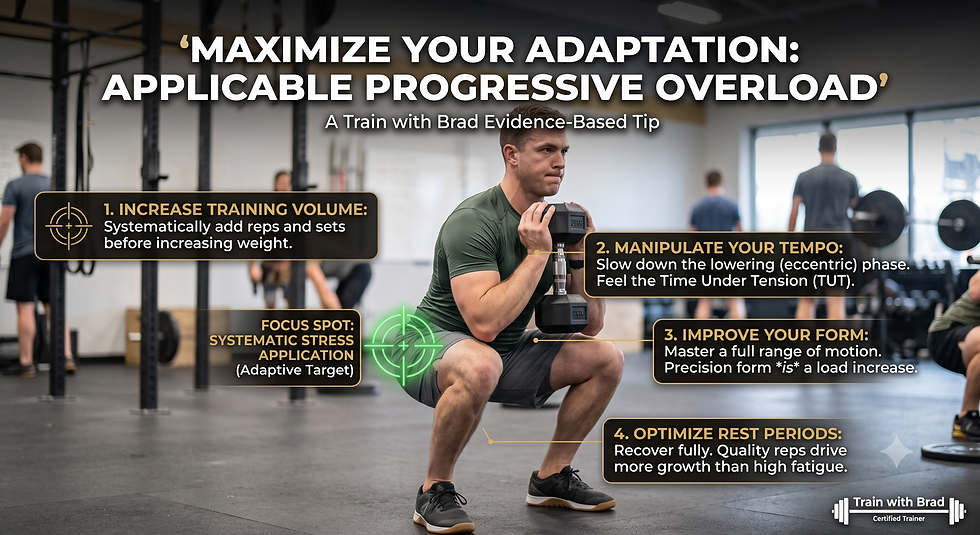
You’ve been hitting the gym consistently, tracking your metrics, and breaking a sweat. But lately, the scale isn't moving, your strength has plateaued, and you're wondering if you've hit a wall.
Most people assume the only way to get stronger or build muscle is to constantly add more weight to the bar. But if you just blindly chase heavier plates, you eventually hit a limit—or worse, wind up with an injury that sidelines you. Enter progressive overload, the fundamental biological principle that forces your body to adapt, grow, and get stronger. As an evidence-based strength training coach here in Reston, VA, I teach my clients that weight is just one lever you can pull.
To understand why, we have to look at the physiology of progress. Your body is incredibly efficient; it hates wasting energy. If you lift the exact same weights for the exact same reps every single week, your muscles have zero biological reason to adapt.
Muscle growth and strength gains rely on the Stress-Recovery-Adaptation cycle. Training creates microscopic tears in muscle tissue, proper recovery repairs that damage, and the body adapts by rebuilding the tissue slightly stronger to handle that specific stressor next time. To keep seeing results, you must systematically increase the training stress over time. But that stress doesn't have to mean compromising your joints with unsafe weight.
Here are four highly effective ways to progress your exercises safely.
1. Increase Your Training Volume
Before you reach for a heavier dumbbell, master the one you currently have by doing more total work with it. If you can perform 3 sets of 8 reps of a dumbbell bench press with perfect form, don't jump to the next pair of dumbbells yet. Next week, strive for 3 sets of 10. The following week, aim for 3 sets of 12. Once you hit the top of that rep range with flawless execution, then increment the weight.
2. Manipulate Your Tempo
Time under tension is a massive driver of muscle growth, yet most people drop weights fast and let gravity do half the work. Try slowing down the movement. When squatting, for example, take a full three to four seconds to lower yourself to the bottom position, pause for a split second to eliminate momentum, and then explode up. You will make a lighter weight feel significantly more challenging while sparing your joints.
3. Master Your Form
True progression can simply mean doing the exact same workout, but doing it significantly better.
Are you using momentum, swinging your hips, or cutting your range of motion short just to move a weight? Eliminating the cheat is a form of overload. Sinking a squat one inch deeper, pausing at the peak contraction of a row, or fully stabilizing your core during an overhead press all represent an increase in localized muscle stress without adding an ounce of physical weight to the bar.
4. Optimize Your Rest Periods
If you can perform the exact same workout but with shorter rest intervals - while maintaining your performance and technical form - you have successfully increased your body’s metabolic efficiency and work capacity. If you typically take two minutes of rest between sets of rows, try reducing that rest to 90 seconds. Keeping performance identical under higher fatigue conditions is a massive win for building endurance and changing body composition.
To see how this looks in practice, a structured four-week cycle might take a standard exercise like a dumbbell Romanian deadlift and manipulate these variables week by week, rather than just changing the plates.
Week | Target Weight | Sets x Reps | Tempo (Lower / Pause / Lift) | Focus |
Week 1 | 40 lbs | 3 sets x 8 reps | 2 sec / 0 sec / 1 sec | Establish baseline form and control. |
Week 2 | 40 lbs | 3 sets x 10 reps | 2 sec / 0 sec / 1 sec | Volume Progression: Added reps. |
Week 3 | 40 lbs | 3 sets x 10 reps | 3 sec / 1 sec / 1 sec | Tempo Progression: Increased Time Under Tension. |
Week 4 | 45 lbs | 3 sets x 8 reps | 2 sec / 0 sec / 1 sec | Load Progression: Stepping up safely. |
Fitness isn't about throwing random exercises together and hoping for the best; it’s a science.
When you track your variables—reps, tempo, rest, and form—you unlock the ability to make predictable, lifelong progress without burning out.
If you are ready to stop guessing, break through your plateaus, and want a customized, evidence-based strategy, let's connect. I work with clients right here in Reston, Virginia, helping them master their movement and build sustainable strength.
About the Author
Brad Neufeld is an ACE-certified personal trainer based in Reston, Virginia, working with clients in person and online across Northern Virginia.


Comments